Your competitor appears in an AI answer. Your business does not.
Before rewriting your website, check three things: Does the answer mention your business? Does it link to your website? Is the information accurate?
An AI visibility audit helps you answer these questions using searches your customers would actually make. Here is how to check your visibility, record what you find and decide what to improve first.
Key Takeaways
- Test questions customers ask before they know your business name.
- Record brand mentions, recommendations and website citations separately.
- Keep ChatGPT search, Google AI Overviews and Google AI Mode in separate records.
- Repeat the checks before drawing conclusions from a single answer.
What Is an AI Visibility Audit?
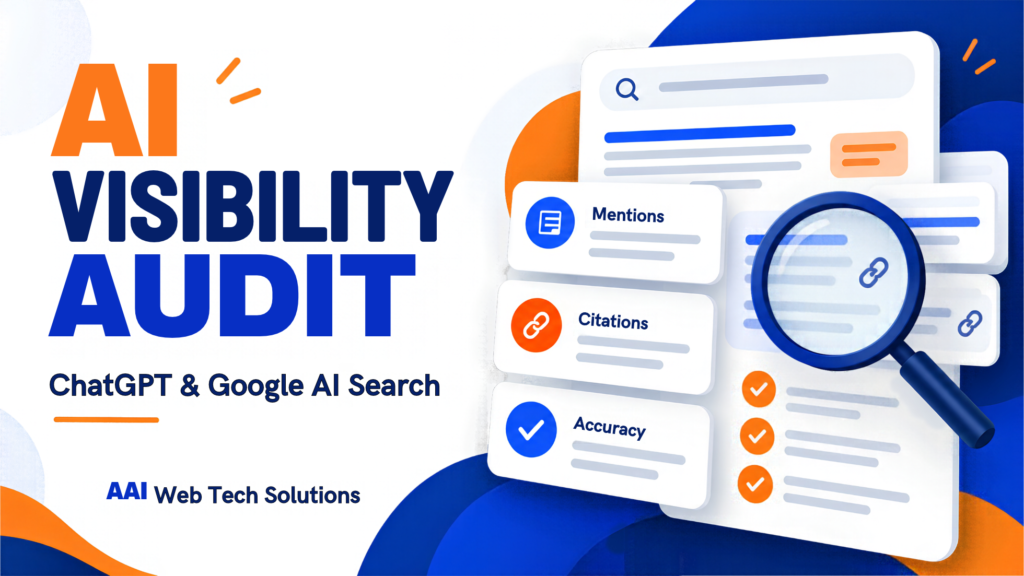
An AI visibility audit checks how your business appears in AI-generated answers, which sources those answers use and where competitors appear instead.
There are three things to look for:
- Brand mention: Your business is named in the answer.
- Website citation: A source link points to a page on your website.
- Recommendation: The answer suggests your business as an option for the customer's stated need.
These are different outcomes. An answer might mention your business without recommending it. It could also link to one of your articles without naming your company. And none of them proves that someone visited your website or sent an enquiry.
The aim is to understand whether potential customers can discover your business and whether the information they receive is correct.
Step 1: Start With Questions Your Customers Actually Ask
Choose one service, one customer group and, where relevant, one location. Checking everything at once makes results harder to interpret. Then start with six questions: two from each group below.
For example, a Mohali accounting firm serving online sellers could use the following. These examples are for illustration only. Replace them with your own service, customers and location.
Discovery Questions
These check whether your business appears when someone does not already know your name.
- Which accounting firms in Mohali work with small businesses?
- Which companies offer bookkeeping for Shopify and Amazon sellers in India?
Leave your business name out of these questions. Otherwise you are prompting the answer to discuss you instead of checking whether you appear independently.
Brand Questions
These help you check whether AI answers describe your business accurately.
- What services does [Business Name] provide, and who are they for?
- Where is [Business Name] based, and which locations does it serve?
Look for incorrect services, old contact details, unclear descriptions or confusion with another company. Keep these results separate from discovery results.
Buying Questions
These show which advice and sources appear when someone is considering a service.
- What should an online seller ask before hiring a bookkeeper?
- How should a small business compare monthly bookkeeping services?
Your website might be cited for these questions even if your company is not recommended. This shows which pages are being used as sources in that answer.
Use your enquiry emails, sales calls and frequently asked questions as the starting point. Real customer wording is usually more useful than phrases chosen only because they sound like SEO keywords. Six questions is a manageable starting point, not an industry standard.
Your next step: Save six questions and use the same wording throughout your first audit.
Step 2: Check Your Business in ChatGPT Search
Open a fresh chat and select the search option. Confirm that the response actually used web search and gave sources you can inspect. OpenAI explains how in its ChatGPT search guide.
Run each question separately and save the first answer before asking any follow-up. Then check:
- Is your business mentioned?
- Is it recommended for the customer's needs?
- Does a source link point to your website?
- Which competitors appear?
- Are your services, location and business details correct?
If your company is missing and you follow up with "What about [Business Name]?", the new answer helps you see how you are described. It does not change the original discovery result, because you supplied the name. Label the two observations separately.
Open the Sources
Do not rely only on the answer. Open the links connected to your business and check where the information came from: your homepage, a service page, a blog article, a directory or a third-party article. Does the page really support what the answer says?
For example, ChatGPT might mention your company but link to a business directory. Record that as a brand mention, save the directory URL and note that it is not a citation to your own website.
Note the Test Conditions
A fresh chat reduces the influence of earlier messages, but location and personalisation can still affect answers. Record the date, language, location, sign-in state and search mode so you can compare results fairly later.
If you cannot confirm that search was used, record "Search use unconfirmed." Do not count it as a searched answer where your business failed to appear.
Your next step: Save each answer or a screenshot, along with the source URLs.
Step 3: Check Google AI Overviews and AI Mode Separately
Google AI Mode is available in India, including in English and Hindi, according to Google's availability guidance. Test in the language your customers normally use. If you check both English and Hindi, keep separate records for each.
There are two Google experiences to check.
Google AI Overviews
Search for your question on Google and look for an AI Overview. If one appears, read the answer, the business mentions and the source links.
If none appears, record "Feature not shown." That is different from an AI Overview appearing without your business. Also remember that a service page listed below an AI Overview was not necessarily cited by it.
Google AI Mode
Run the same question in the AI Mode tab. Record whether your business is mentioned or recommended, whether your website is cited and whether the details are accurate.
Keep AI Mode results separate from AI Overview results. The answers and supporting sources can differ. Google's official guidance on AI features explains how these experiences relate to Google Search.
Your next step: Create separate entries for ChatGPT search, Google AI Overviews and Google AI Mode.
Step 4: Record Your Findings in a Simple Spreadsheet
A spreadsheet makes it easier to compare results without relying on memory. Use one row for each question, platform and test run.
Include these details in your audit log:
- Date and exact question
- Question type: discovery, brand or buying
- Platform, mode and language
- Location and relevant settings
- Whether an AI answer appeared
- Brand mention, recommendation and website citation
- Source URLs and competitors
- Incorrect information and your next action
- Screenshot or saved answer
Here is how to interpret common findings. These examples are fictional and are not findings about a real client.
| What You Find | What It Means | What to Do Next |
|---|---|---|
| Your business is named, but the source is a directory. | Brand mention, but no citation to your website. | Check whether the directory information is correct. |
| Your article is linked, but your company is not named. | Website citation without a brand mention. | Check whether the article supports the answer accurately. |
| No Google AI Overview appears. | The feature was not shown for that search. | Record it separately from answers that exclude your business. |
| An answer lists a service you no longer provide. | Your business appears, but the information is outdated. | Review your website and the sources used in the answer. |
Keep mentions, citations and accuracy separate. Otherwise an answer that names your business but gives customers wrong information could look like a success.
Your next step: Complete one row for each question on each platform. Leave unchecked results blank rather than guessing.
Step 5: Compare a Competitor's Page With Your Own
Choose one discovery question where a competitor appears and your business does not. Open the cited pages and look at how clearly they explain the service, the intended customer and the details someone needs before making an enquiry.
Suppose the question is: Which companies offer bookkeeping for Shopify and Amazon sellers in India?
Your page says:
We provide professional accounting services for businesses of all sizes.
That gives the reader very little to go on. If it accurately reflects your service, a clearer version would be:
We provide monthly bookkeeping for Shopify and Amazon sellers, including payment reconciliation, marketplace fee tracking and monthly financial reports.
The second version explains who you help and what the service includes. Support it with useful details:
- What is included in the monthly service?
- Which platforms do you work with?
- What does the customer need to provide?
- How does onboarding work?
- Do you have genuine examples or case studies?
This comparison identifies content gaps you can fix. It does not prove why an AI system selected a competitor. Apply the same check to directories and third-party articles: is there an accurate listing or an information gap you can address?
If your service pages need clearer explanations, our SEO services can help. You can also read why your business may not be appearing in AI search results for a wider checklist.
Your next step: Improve one important service page with specific, accurate details that help a customer decide.
Step 6: Repeat the Check and Choose Three Priorities
Repeat the same questions on another date, keeping language, location and settings as consistent as possible. Compare each platform separately.
Testing your two discovery questions on two different dates gives you four answers to review on each platform. If your business appears in two of those answers on ChatGPT search, write:
Business mentioned in 2 of 4 tested discovery answers.
This result applies only to the answers you tested; it does not measure your overall AI search visibility. Keep brand questions separate from discovery questions, and exclude searches where no AI answer appeared from the mention calculation.
Then choose three priorities.
- Correct inaccurate business information. Start with outdated services, wrong locations and inconsistent details. Check both your own pages and the sources linked in the answers.
- Improve one important service page. Explain who the service is for, what it includes, how it works and how someone can enquire. Use real experience and examples where you have them.
- Investigate technical problems. If an important page is missing from Google or cannot be accessed, check its crawling and indexing status with your developer or SEO specialist.
Assign each task an owner and a review date, and record when changes go live so your next check has context. Avoid treating a result right after an update as proof that the update caused it.
Your next step: Fix the most important gaps before expanding your list of audit questions.
Measure Enquiries Separately From Mentions
A brand mention does not tell you whether someone visited your website or became a customer. Track referral visits, contact enquiries and qualified leads separately, and ask new prospects how they found you.
Google includes traffic from its AI features in Search Console's Web reporting, so the full Web total should not be labelled as AI traffic.
Frequently Asked Questions
How often should I run an AI visibility audit?
A monthly review is a practical starting point. You can also repeat relevant checks after significant website changes. Keep your original questions so you can compare observations over time.
Can I do an AI visibility audit without paid tools?
Yes. You need access to the search experiences you want to check, a spreadsheet and saved answers. Paid tools may help with larger monitoring programmes, but you still need to understand the questions being tested.
Is one mention enough to say my business is visible?
You can say your business appeared in that particular answer. A broader claim needs more observations across relevant questions and dates.
Do I need special AI schema for Google's AI features?
Google says no special schema is required. Focus on useful content and the usual Search requirements, including crawl access and indexing eligibility. Meeting them makes a page eligible; it does not guarantee inclusion.
Find Out What Needs Fixing First
A useful audit gives you a clear next step. That could be correcting an outdated detail, improving a service page or resolving a technical issue.
AAI Web Tech Solutions offers a free SEO audit to help you start reviewing your website. Share your website URL, main service and target location. If you also want to understand your visibility in ChatGPT and Google AI Search, mention that so we can discuss the scope of a dedicated review.
Request Your Free SEO Audit ↗